Processing targets and the $1.5 billion investment
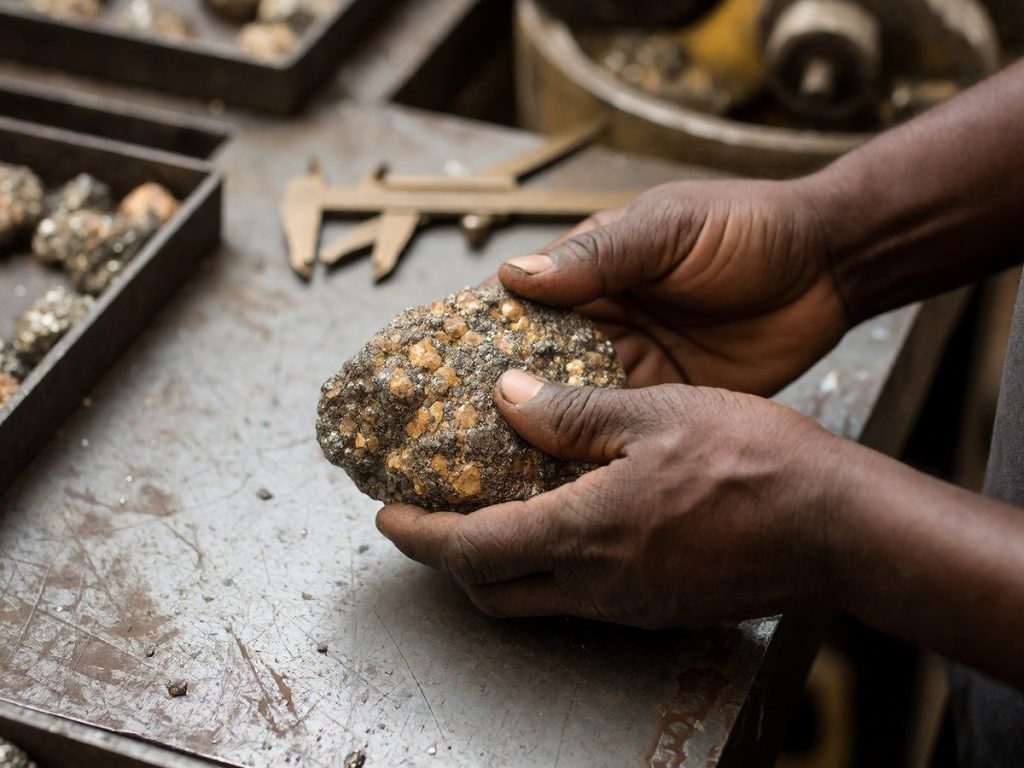
Minister of Lands and Natural Resources Emmanuel Armah-Kofi Buah says the government will end raw mineral exports by 2028. The plan targets 70 per cent local refinement of artisanal and small-scale gold by December 2027 and 100 per cent by December 2028. For manganese and bauxite, the government aims to process 50 per cent locally by 2028 and all production by 2030. This policy involves a $1.5 billion investment in domestic processing capacity for gold, manganese, bauxite, and lithium under the New Economy Programme. To support this, the government will establish a 24-hour critical mineral processing enclave in the Western Region and develop railway infrastructure. The Ghana Gold Board already signed refining agreements with the Gold Coast Refinery and the Royal Ghana Gold Refinery, which each possess the capacity to refine one tonne of gold weekly. Minister Emmanuel Armah-Kofi Buah stated, "The era of exporting our minerals in raw form must give way to one in which we refine, process and manufacture our minerals at home," to ensure domestic economic benefits.
| Mineral | Local Processing Target | Deadline |
|---|---|---|
| Artisanal Gold | 70% | December 2027 |
| Artisanal Gold | 100% | December 2028 |
| Manganese | 50% | 2028 |
| Bauxite | 50% | 2028 |
| Manganese | 100% | 2030 |
| Bauxite | 100% | 2030 |
Revenue leaks and the small-scale mining gap
The government plan to mandate local processing is the only way to capture the $10.8 billion currently lost to raw small-scale gold exports. In 2025, small-scale gold production reached 3.11 million ounces, accounting for 52.4 per cent of national output. The Institute for Fiscal Studies reports that Ghana’s 2025 mining revenue was $1.6 billion against a sector value added of $13.4 billion. This revenue is 11.9 per cent of the total sector value, while the country faces 21.9 per cent unemployment among 15 to 35-year-olds. The 2025 small-scale gold segment produced $10.8 billion in exports. The Institute for Fiscal Studies found no royalties from this segment. The Natural Resource Governance Institute reports that fewer than 10 per cent of small-scale operators pay corporate income tax. These leaks contribute to a $6.56 billion gap in mining revenue compared to Botswana. Ghana also exported 2 million tonnes of bauxite in 2025 while the Volta Aluminium Company smelter in Tema ran at only 23 per cent capacity. Large miners must also sell 30 per cent of output to GoldBod in dore, an increase from the previous 20 per cent requirement. First-half 2026 royalty receipts reached GH¢5.39 billion, almost matching the whole of 2025. The Bank of Ghana reported an operating loss of about GH¢15.6 billion in 2025, which reflects the cost of its gold purchase programme. Official gold reserves fell from 33 tonnes to 24.4 tonnes in the year to June 2026. In the oil sector, Parliament ratified extensions of the Jubilee and TEN licences to 2040 in February 2026. The state petroleum company gains a 10 per cent interest in both fields, though this only begins in July 2036.
Industrial expansion and commodity patterns
The Ghana Integrated Aluminium Development Corporation is pursuing an integrated aluminium industry while the Ghana Integrated Iron and Steel Development Corporation explores iron ore in the Oti Region. On lithium, the Green Minerals Policy requires companies to examine domestic conversion of minerals to retain more value. The government also seeks to strengthen local content so indigenous businesses secure procurement and supply chain opportunities. Joshua Ansah, the Secretary-General of the TUC, says Africa’s dependence on raw mineral exports deprives the continent of jobs and technological development. He argues that the continent must prioritise local mineral processing and technology transfer. The state-owned Tema Oil Refinery struggled for nearly eight years to process the country’s crude, despite the June 2026 delivery of Jubilee crude to the Sentuo refinery being the first such cargo refined at home, fifteen years after first oil. Ghana also exports much of its agriculture raw, including 250,000 tonnes of cashew, 145,000 tonnes of rubber, and 130,000 tonnes of shea, with 95, 95, and 90 per cent exported raw respectively. A 2026 study by the French non-profit Nitidae found that Ghana processed only about 15,000 tonnes of its 262,000-tonne cashew crop in 2025. The state previously attempted nationalisation in 1961 when the State Gold Mining Corporation took over five mines. By 1972, the state held 55 per cent of Ashanti Goldfields, though gold output fell from over 900,000 ounces in the early 1960s to 280,000 in 1983.