Facility funding and training
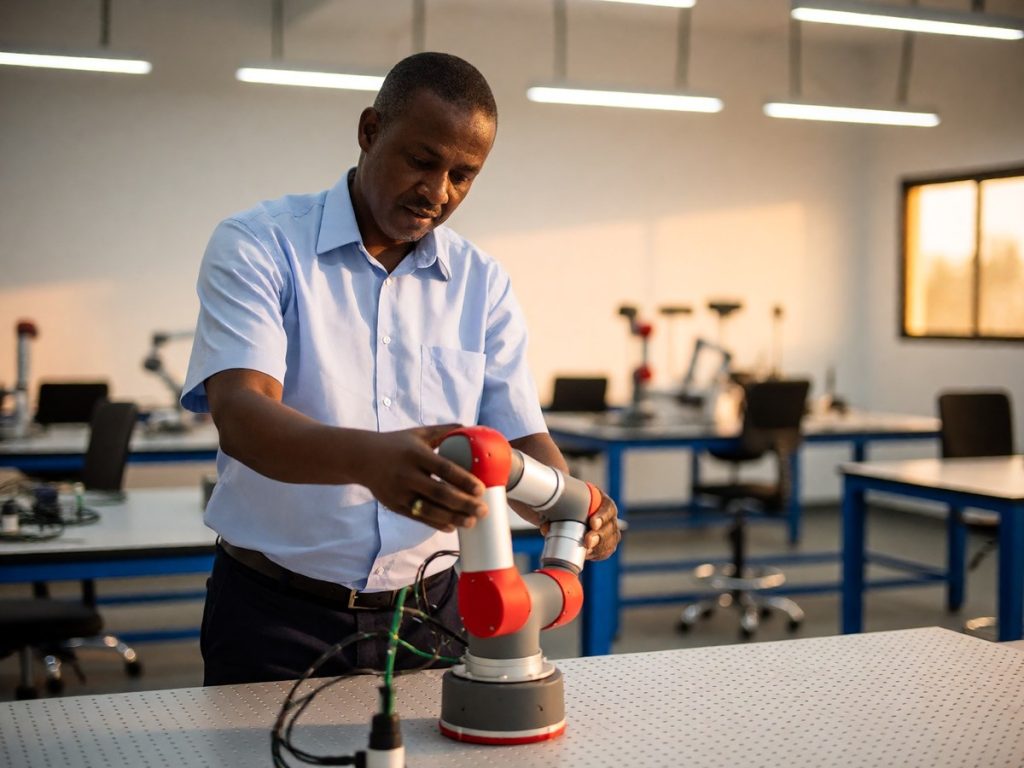
UMaT opened the RobotechLab at its Department of Computer Science and Engineering to provide practical ICT-based robotics and automation training. The facility resulted from a strategic partnership between UMaT, IBES AG and the German development agency, GIZ. The project costs more than €400,000, with GIZ and IBES AG providing the funding while UMaT contributed more than €50,000 in laboratory space and institutional resources.
| Feature | Value |
|---|---|
| Total Project Funding | > €400,000 |
| UMaT In-kind Contribution | > €50,000 |
| Staff Training Participants | ~20 lecturers |
| Primary Funding Partners | GIZ, IBES AG |
Professor Bernard Kumi-Boateng said the facility responds to global demand for professionals in robotics and automation, as well as other ICT-driven technological fields. The university selected approximately 20 lecturers and staff from various departments for a training-of-trainers programme facilitated by IBES and its German partners to develop robotics curricula and conduct research, while also teaching professional short courses. This initiative helps UMaT introduce industry-relevant academic programmes that respond to emerging technological trends. The facility provides a platform for translating academic knowledge into practice and deepening collaboration between the university and industry. The laboratory also bridges the gap between academic training and industry requirements.
Implementation and practical goals
Resal Saberi, the Project Manager of GIZ develoPPP, stated that the German Federal Ministry for Economic Cooperation and Development (BMZ) supports the project through the develoPPP programme. Saberi noted that technological advancement alone cannot drive development without people who can understand, operate, and maintain those technologies. She cautioned that the success of the laboratory depends on practical learning and innovation, as well as industry collaboration.
The laboratory aims to address the challenge of ensuring that knowledge acquired in educational institutions translates into practical skills and employment opportunities. Saberi noted that IBES AG brings private-sector and technology expertise to the partnership, while GIZ facilitates the collaboration to promote sustainable development outcomes. She challenged students and professionals to use the facility to experiment and develop solutions for the workplace, while she also urged businesses to engage with the university to identify practical challenges and support training. "The RobotechLab will provide students and professionals with opportunities to gain hands-on experience in ICT-based robotics and automation, helping them strengthen their competencies to respond to the changing labour market," Saberi stated.